
Media literacy · Guide
How to Fact-Check a Video in Real Time (2026 Guide)
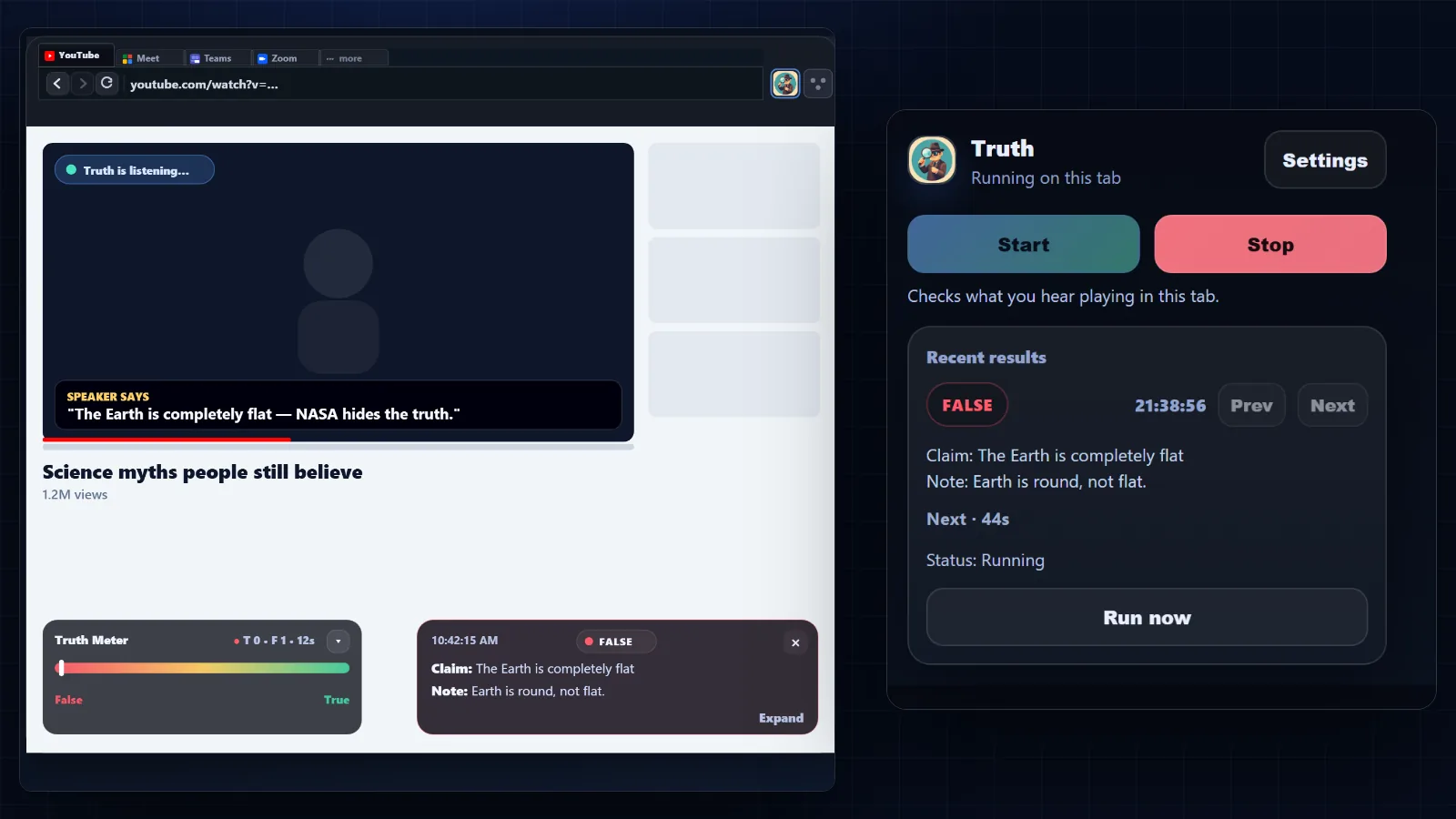
The World Economic Forum ranked misinformation and disinformation the single biggest short-term global risk for 2024 and again for 2025, ahead of extreme weather and armed conflict. (WEF Global Risks Report) Most of that false information now reaches you through video: a clip, a livestream, a podcast, or a meeting recording. This guide shows you exactly how to fact-check a video claim: step by step, and in real time.
Here is the problem. False claims travel faster than corrections. A landmark MIT study of 126,000 stories found that falsehoods were 70% more likely to be shared and reached their first 1,500 people about six times faster than the truth. (MIT Sloan) By the time a claim in a video is debunked, it has usually already shaped what millions of people believe. If you want an accurate picture of the world, you have to check claims as you encounter them, not days later.
- Why fact-checking video is harder in 2026
- Step 1: Capture the exact claim
- Step 2: Separate the checkable fact from opinion
- Step 3: Trace it to a primary source
- Step 4: Cross-check independent sources
- Step 5: Decide the verdict
- Quick heuristics: spotting a false claim
- How to fact-check videos automatically while you watch
- Frequently asked questions
Why fact-checking video is harder in 2026
Text is easy to search; spoken claims are not. When a presenter says a statistic out loud in a fast-moving video, there is no headline to copy, no link to click, and no time to pause without losing the thread. Add the surge in AI-generated video and synthetic voices convincing enough that most people admit they struggle to tell whether online content was produced by a human or a machine. The old advice to “just check the source” stops being practical.
The cost is not only being wrong. In the American Psychological Association’s 2025 survey, a majority of U.S. adults named the spread of misleading information as a significant source of stress. (APA) The goal of fact-checking is not to distrust everything. It is to spend your attention on what is actually true. Here is the repeatable method professionals use, compressed into five steps.
Capture the exact claim
Pause and write down the claim in the speaker’s own words. Precision matters: “vaccines cause autism” and “a retracted 1998 paper claimed a link that has since been disproven” are different claims. If the video has captions, copy the sentence verbatim. If it is audio only, note the timestamp so you can replay it. A claim you have paraphrased loosely is a claim you will check incorrectly.
Separate the checkable fact from opinion
Not everything can be fact-checked. “This policy is a disaster” is an opinion; “this policy raised costs by 40%” is a checkable claim. Strip the sentence down to its verifiable core: a number, a date, an event, an attribution, or a cause-and-effect statement. If what remains is a value judgement or a prediction about the future, label it as opinion and move on. You cannot verify it, only weigh it.
Trace it to a primary source
The first search result is rarely the origin of a claim. It is usually someone repeating it. Follow the chain back to the primary source: the official statistics release, the peer-reviewed paper, the court filing, the original reporting. When a video says “studies show,” your job is to find the study and read what it actually measured. Claims that dissolve when you look for their source are the clearest signal of misinformation.
Cross-check independent sources
One source is a data point; agreement between independent sources is evidence. Confirm the claim against at least two outlets that do not share an owner or an agenda. If every result traces back to the same origin, you have one source wearing different hats, not corroboration. Watch for the tell-tale gap between what a headline claims and what the underlying data supports.
Decide the verdict
Now judge. A useful scale is broader than true or false: a claim can be true, false, partly true, misleading (technically accurate but presented to deceive), or unverified (no primary source exists yet). Being honest about “unverified” is a feature, not a weakness; it is what separates fact-checking from guessing.
Done properly, those five steps take several minutes per claim. A fast talker can make a dozen checkable claims a minute. That mismatch is the whole problem, and it is what real-time tools are built to solve.
Quick heuristics: how to spot a likely false claim in seconds
When you do not have time for the full five-step method, a handful of red flags catch most misinformation. None of them prove a claim is false on its own, but the more that stack up, the more skeptical you should be:
- No source, or a vague one. “Studies show” or “experts say” with no name, date, or link is the most common tell.
- A number that is suspiciously round or extreme. Precise real-world statistics are rarely “exactly 90%.”
- Emotional language doing the persuading. If the claim leans on outrage or fear instead of evidence, treat the evidence as missing.
- It confirms your existing beliefs a little too neatly. Novel, satisfying claims are the ones we share without checking, and the ones most likely to be false.
- The headline says more than the study. A correlation reported as a cause, or a small sample presented as settled fact.
- It cannot be traced upstream. If every version of the claim links to another repost rather than an original source, there may be no original at all.
These heuristics are fast but fallible; they tell you where to look, not what is true. For anything that matters, fall back to Step 3 and find the primary source. Better still, let a tool run that check for you the moment the claim is spoken.
How to fact-check videos automatically while you watch
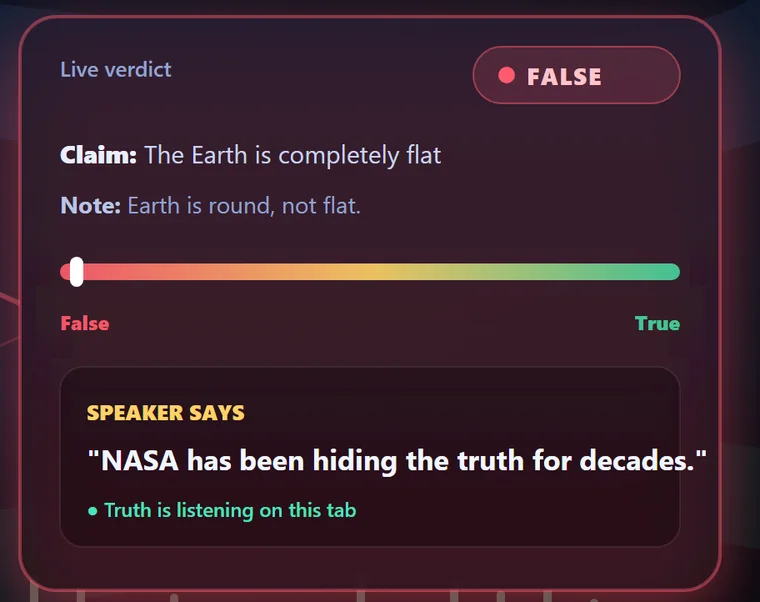
The manual method is reliable but slow, which is why almost nobody does it while a video is playing. The 2026 answer is to let software run those five steps for you in the background. Truth by LetBe.ai is a Chrome extension built for exactly this: you press Start on the tab you are watching, and it captures a short audio or caption window, sends it through an AI verification workflow, and shows a verdict (TRUE, FALSE, MISLEADING, OPINION, or UNCLEAR) right on the page, without pausing the video.
It is not magic, and it is not a replacement for judgement. Truth is an AI-assisted research aid: it is fast at surfacing a likely verdict and the reasoning behind it, but you should still confirm anything important against the primary sources, the same Step 3 above. What it changes is the economics of checking. When a verdict appears in a second instead of five minutes, you actually check claims instead of letting them slide.
Fact-check the next video you watch
Add Truth to Chrome, press Start on any tab, and see AI-assisted verdicts while you watch. Guest credits included.
Whether you check by hand or with a tool, the principle is the same: a claim is only as good as the primary source behind it. Build the habit of asking “where did that number come from?” and you will spot most misinformation before it spreads, which, given how much faster falsehoods travel, is the only place worth catching it.
Frequently asked questions
How do you fact-check a video quickly?
Capture the exact claim, separate the checkable fact from opinion, then confirm it against two or more independent primary sources such as official data, peer-reviewed research, or original reporting. A real-time fact-checking tool can run these steps automatically while you watch.
Can you fact-check a video while it is playing?
Yes. Browser tools like Truth by LetBe.ai capture a short audio or caption window from the tab you are watching, send it to an AI verification workflow, and show a verdict on the page without pausing the video.
How can you tell if a video claim is misinformation?
Misinformation often lacks a verifiable primary source, uses emotionally charged language, cites a study without a link, or contradicts the consensus of independent authorities. If a claim cannot be traced to a credible original source, treat it as unverified.
What are the best sources for fact-checking?
Prioritise primary sources: official statistics agencies, peer-reviewed journals, court records, and original reporting from established newsrooms. Independent fact-checking organisations are useful starting points but should link back to primary evidence.
Is fact-checking AI accurate?
AI-assisted fact-checking is a research aid, not a guarantee. It is fast at surfacing likely verdicts and sources, but it can be wrong. Always confirm important claims against the primary sources it points to before relying on them.

Truth is an AI-assisted claim-checking Chrome extension built on LetBe.ai, a hosted platform for running AI workflows. We write about media literacy, misinformation, and verifying what you watch. Truth is a research aid, not a guarantee of truth; always confirm important claims with primary sources.